
Your website copy is so safe it says nothing.
If that stings a little, stay with me, because it happens to good businesses more often than you’d think.
Take one of my clients. He’s afraid of his own website, convinced one wrong word could get him sued. So every service he’s worked years to build gets squeezed into a paragraph of neat, careful language, the kind that couldn’t upset a judge or excite a single customer.
He runs a moving and storage company that offers four services: home and office moves, packing, storage, and junk removal. All four show up on his homepage and his services page, but each one gets about a paragraph, and some get even less. Someone looking for storage lands on his site, reads a generic blurb about moving, and bolts.
Every word is safe, and nobody remembers a thing.
Does he play it safe on purpose?
You bet he does, and like a lot of business owners, he has his reasons.
When he, his business partner, and I went over the copy together, he stopped me at almost every line: “Not this. Not that. We can’t promise that. That could get us sued.”
In his mind, say “gentle handling” and a scratched dresser becomes a broken promise, and say “secure storage” and a break-in turns into a lawsuit. So he stuck to lawsuit-proof words like “solutions,” “services,” and “your needs,” which is how his services page ended up with this:
We offer a full range of moving solutions, including packing, storage, and junk removal, to meet your needs.
If your eyes glazed over somewhere around “a full range of moving solutions,” don’t feel bad, because so do his customers’.
Nothing in that sentence is wrong, and nothing in it could get him sued, but swap “moving” for “plumbing” and a plumber could post it tomorrow without anyone in town noticing, which tells you how little it says about him.
It also squeezes three services into one line and treats storage like a footnote, which is exactly how customers read it.
What vague copy costs him
People skim websites because that’s how we look for information online. Research from Nielsen Norman Group shows that visitors decide within the first 10 seconds whether a page is worth their time. People read only about 20% of the words on it.
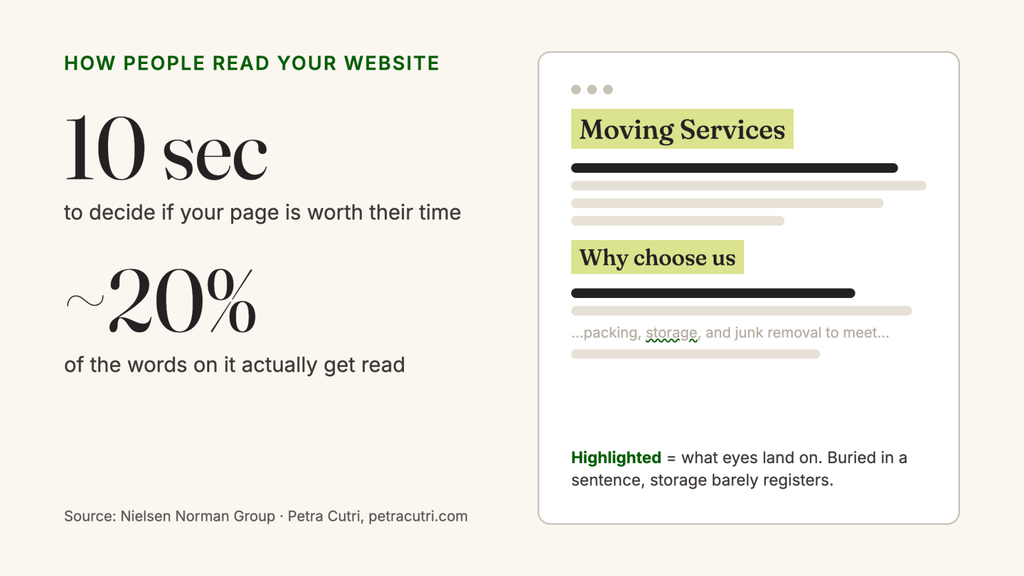
In those few seconds, our eyes jump to headings, bold words, and the first line of each section, so a service without its own heading barely registers.
And even when a visitor slows down to read, if the paragraph about your service can’t tell them whether what you offer is for them, what’s included, how it works, and whether you cover their area, they leave your site without a peep.
Search engines skim too, but they can’t fill in the blanks the way people do. A person might guess that a moving company also stores things, while Google looks at the page title, the main headline (the H1), and the headings to decide what a page is about. So if storage never shows up in a heading, Google has little reason to think this company does storage.
AI tools read websites for the same clues, which is a big part of why ChatGPT recommended my client’s competitor in a previous post.
What the law cares about
His instinct to be careful makes sense. Advertising law in the U.S. generally leaves vague praise like “quality service” alone, because nobody takes it seriously enough to be misled by it. So his safe words are legally safe for the same reason they don’t sell anything.
What the law pays attention to are specific claims, which need to be true, and guarantees, which you have to honor. The law doesn’t ask you to be vague. It asks you to be truthful.
The FTC says it plainly in its guide for small businesses: advertisers “must have evidence to back up their claims.” You can read it yourself in Advertising FAQ’s: A Guide for Small Business.
If you’re unsure about certain words in your industry, especially anything that sounds like a promise or a guarantee, run them by your lawyer. A quick check costs less than a website that says nothing.
How can you be specific without making promises?
Describe what you do instead of promising how it turns out.
A promise: “Your belongings will arrive damage-free.”
A description: “We wrap furniture in moving blankets and stretch film before it goes on the truck.”
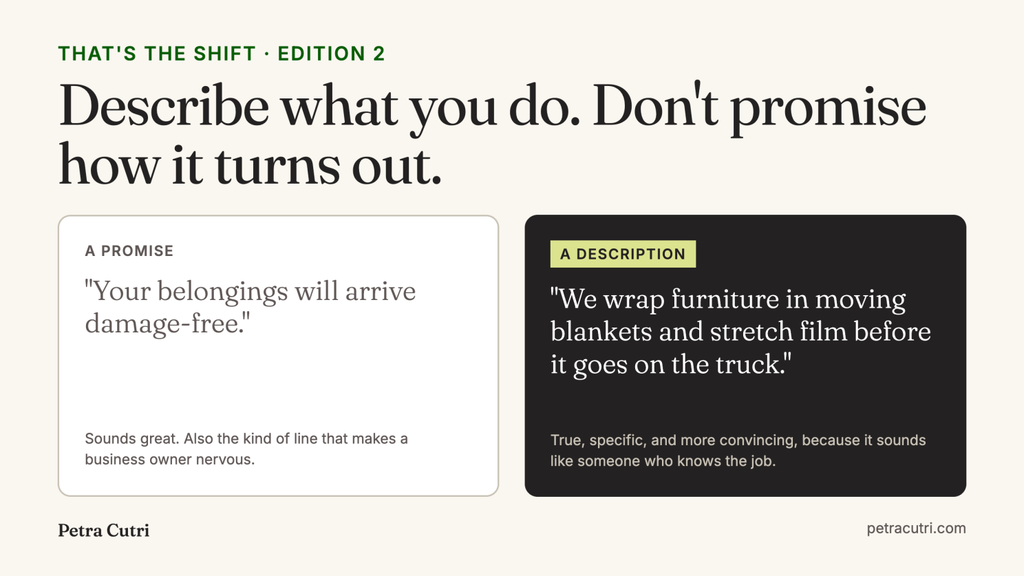
The second one doesn’t guarantee anything, as long as his crew really does it, and it’s more convincing because it sounds like someone who knows the job.
The same goes for who a service is for, what’s included, sizes and options, the areas you serve, and how it works from start to finish.
It’s toasted
One of my favorite shows is Mad Men. Please, don’t tell anyone I’ve watched it three times (ahem). What hooked me was the window into the culture back then, when everyone smoked at their desks and slapping a secretary on the backside passed for office manners. But I’m getting sidetracked.
In the very first episode, Don Draper pitches Lucky Strike, a tobacco company, a new slogan: “It’s toasted.” The client, incredulous, points out that every tobacco company toasts its tobacco. But Don doesn’t budge: “No. Everybody else’s tobacco is poisonous. Lucky Strike’s is toasted.”
Don’s trick was to say out loud what every company already did, so Lucky Strike owned it, and you can pull the same move without his spin, because yours is true. Your competitors might wrap furniture too, but if their websites don’t say so and yours does, you’re the one customers remember for it.
What I told him
Ask a business owner what they do, and they’ll talk for ten minutes, but look at their website and it gets a paragraph. So the hard part is already done, because he knows his business inside and out.
How you talk on your website should be no different.
Write like your customer is sitting across from you. If someone walked into his office and asked about storage, he wouldn’t say “we offer storage solutions to meet your needs.” He’d tell them how big the units are, how they get access, and how long they can rent, and that conversation is what the page should say.
Give the main services their own pages. Not necessarily all four right away, but at least the three that bring in the most business, each with its own title, its own H1, and enough detail to answer the questions customers ask.
We’re still at it, and if he reads this, I hope he laughs at the plumber joke and then calls me about the storage page.
Your turn
So do me a favor. Open your website and find the service that brings in the most money. Does it have its own page? Or is it sharing a paragraph with three others?
And if you open it up and aren’t sure what to change, I’m happy to take a look at your copy with you. Grab a time on my calendar.